Sunday, August 29, 2010

Paul Allen Sues Google, Yahoo, Facebook, Others Over Patents

An article on "Search Engine Land" says that Paul Allen Sues some high powered companies.

Paul Allen, the Microsoft co-founder and one of the richest men on earth, has filed a patent infringement suit today against several Internet titans, the Wall Street Journal reports.

The lawsuit centers on technology developed a decade ago by Interval Research Corp., a technology lab that Allen owned between 1992 and 2000. Eleven companies are named in the lawsuit: Google, Yahoo, Facebook, AOL, eBay, YouTube, NetFlix, Office Depot, OfficeMax, and Staples. The lawsuit claims four patent violations of technologies that are widely used by search engines and e-commerce sites, according to the WSJ:

The technology behind one patent allows a site to offer suggestions to consumers for items related to what they’re currently viewing, or related to online activities of others in the case of social networking sites.

A second patent, among other things, allows readers of a news story to quickly locate stories related to a particular subject. Two others enable ads, stock quotes, news updates or video images to flash on a computer screen, peripherally to a user’s main activity.

A Google spokesperson gave this statement to the WSJ:

This lawsuit against some of America’s most innovative companies reflects an unfortunate trend of people trying to compete in the courtroom instead of the marketplace.

A Facebook spokesperson told the Journal, “We believe this suit is completely without merit and we will fight it vigorously.”

The lawsuit doesn’t include a damage estimate.

There’s more discussion at Techmeme.
Digg! 

Wednesday, July 14, 2010

Here comes YouTube Mobile

It’s well known that the mobile internet is huge and growing fast; what’s surprising is exactly how fast. According to a recent report, within 5 years more users will connect to the internet via mobile devices than desktop PCs. YouTube consumption on mobile devices has also grown considerably -- playbacks were up 160% in 2009 over the previous year. And we’re excited to announce that YouTube Mobile now receives more than 100 million video playbacks a day. This is roughly the number of daily playbacks that YouTube.com was streaming when we joined forces with Google in 2006.

Google launched YouTube on mobile devices in 2007 with about 1,000 videos available on the mobile site (m.youtube.com). While this suddenly opened up the possibility to access videos on the go, our site, mobile browsers and the hardware had limitations that prevented the mobile experience from keeping up with YouTube on the desktop. Today, more than ever, Google knows that you want to be able to find and access your favorite videos wherever you are. That’s why Google has been working hard to roll out an updated version of the mobile site.

Here's what's new about the new mobile site:

* It's really fast.
* The new user interface incorporates larger, more touch friendly elements, making it easier to access videos on the go.
* It incorporates the features and functionality you’ve come to expect from the .com site, like search query suggestions, the options to create playlists,the ability to designate “favorite,” “like,” or “unlike” videos directly from your device.
* As Google makes improvements to Youtube.com, you’ll see them quickly follow on the mobile site, unlike native apps which are not updated as frequently.

As the world continues to go mobile, Google thinks this is a great improvement for users who want a more consistent YouTube across many devices, no matter where they are. Google is launching in English only today, but will be rolling it out in other languages in the coming months. You can access the latest YouTube mobile site from your iPhone or Android browser. To learn more, visit m.youtube.com to check out the latest improvements and take a minute to watch this demo video:

Digg!

Monday, July 12, 2010

Blogger in the News - Lunch Box Mom

This article is about Sarah Vander Schaaf - one exhausted mama with a baby that didn't sleep. She started blogging on blogspot about her daughter that didn't sleep. Like many other bloggers she connected with other moms. She did Q and A with moms at the playground and wrote about topics near and dear to her heart ad a mommy. Her blog is now receiving national attention as she is now part of a milk promotion.

Here is a link! Congrats Lunch Box Mom. http://lunchboxmom.blogspot.com/

Digg!

Sunday, July 11, 2010

Paid Search for your Personal Mom Blog

Paid Search for your Mom Blog. Why would I spend money on a personal blog?

You spend money on your mom blog for the same reason you would pay for a web design. I started www.powellmom.com with the sole purpose of becoming a high traffic Mommy Blog. The two tactics that I am using for this blog are paid search and SEO. I promise to do a post later on SEO for the mom blog. But the purpose of this post is to talk about why you should consider Paid Search as a method for gaining traffic.

You could be the best funniest blogger in the world and if no one finds your blog then you won't get traffic. One of the problems with mom bloggers in general is that they tend to play in the same circle. Mom blogs are funny creative and most of them share a common purpose. Once you want to get a real amount of traffic, you need to get bloggers outside of the mom circle to come to your site.

This is where paid search comes into play. Suppose you are a mom blogger that discusses what it is like to live in Chicago. Consider advertising for your blog on a Chicago website. Do you always walk down to the same bookstore for their story hour events? Consider buying an ad for your mommy blog on the site? These are just a few creative ways to make some money on your blog. They are inexpensive but can yield a small local following, which can enhance the reach of your blog.

Digg!

Saturday, July 10, 2010

Blogtimize - Optimize the ads on your blog

Not sure how many people have already read these tips but these are right from Google and so they should help your ads perform. I understand you don't want to have your blog too cluttered so I would not necessarily take every bit of advice, but the concepts are good.

When working with a blog, you're facing some interesting ad implementation challenges: a predetermined page format, highly targeted content, and regular visitors, among other things. To make the most of your readership and content, here are a few suggestions:

Blend ads into your blog

To increase the likelihood that your readers will see and click on your ads, blend your ad units into the background of your blog. Choose a bold color for the ad title to help draw attention to your ads, then make sure that the background and borders of your ads are the same color as the background of the area where the ad is placed.

Map

Experiment with multiple ad formats and locations

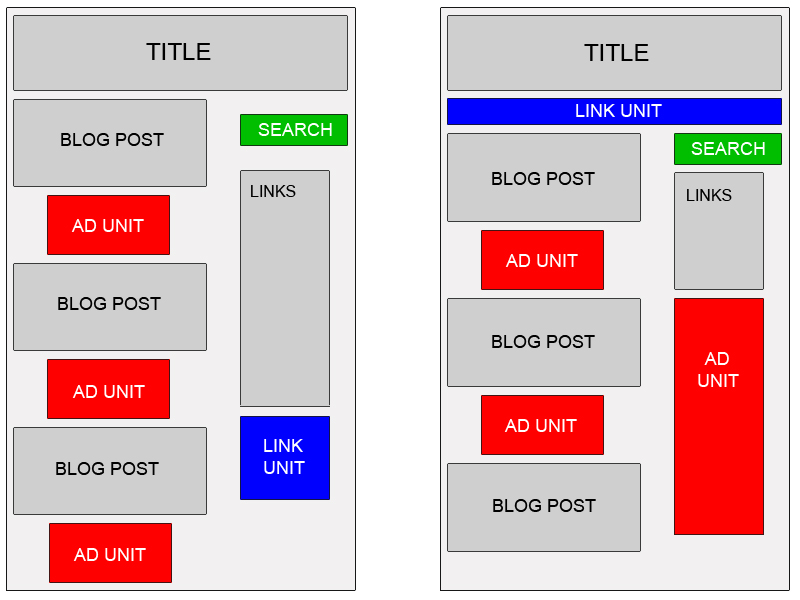
In general, wider ad formats tend to be more reader-friendly. Placing an ad unit after the first post will likely catch your readers' attention. Take a look at our sample implementations to get some ideas. Also, consider placing a Skyscraper (120x600) or vertical link unit on the right side of your blog. If you're using Blogger, you can find instructions on placing AdSense code in your blog's sidebar.

Offer readers more options with search

To make sure you're earning the most revenue possible with AdSense, go beyond just ads to use AdSense for search. You can increase your earnings, provide readers with valuable information, and take advantage of flexible formats.

Improve ad targeting

With section targeting, you can target an ad unit to a specific section of your blog, as well as block out irrelevant sections like navigational links. We recommend that only those familiar with HTML attempt to implement section targeting.

Tip for promoting your blog: If you're a Blogger user, activate this setting to notify Weblogs.com, a blog update notification service, whenever you have updated your blog. That means your blog will be included in various "recently updated" lists on the web as well as other blog-related services


Digg!

Friday, April 23, 2010

Honey, Don’t Bother Mommy. I’m Too Busy Building My Brand.

ON a brisk Saturday morning this month, a dedicated crew of about 90 women, most in their 30s or thereabouts, arrived at a waterfront hotel here, prepared for a daylong conference that offered to school them in the latest must-have skill set for the minivan crowd.

Teaching your baby to read? Please. How to hide vegetables in your children’s food? Oh, that’s so 2008.

The topics on that day’s agenda included search-engine optimization, building a “comment tribe” and how to create an effective media kit. There would be much talk of defining your “brand” and driving up page views.

You know. For your blog.

Yes, they had come to Bloggy Boot Camp, the sold-out first stop on a five-city tour. It is the brainchild of Tiffany Romero and Heather Blair, the founders of the Secret Is in the Sauce, a community of 5,000 female bloggers. Boot Camp is at once a networking and social event, bringing together virtual friends for some real-time girly bonding, and an educational seminar designed to help the participants — about 90 percent of them mothers — to take their blogs up a notch, whether in hopes of generating ad revenue and sponsorships, attracting attention to a cause or branching out into paid journalism or marketing.

“You’re here because you want to be seen as a professional,” Ms. Romero told the group. A summer-camp director from Los Angeles, she steered the proceedings with the good-natured sass of a sorority social chairwoman and the enthusiasm of a, well, summer-camp director. (She went barefoot for much of the day and said “You guys!” a lot.)

After the obligatory announcement that participants — who had paid $89 and traveled from as far as California — should “feel free to tweet” (hashtag: bloggybootcamp), the women splayed their laptops, pecked at their BlackBerrys and traded business cards. A handful drank mimosas out of brightly colored plastic sippy cups.

“Do I call you ‘Jill’ or ‘Scary Mommy?’” a participant asked Jill Smokler, a speaker whose blog, about her life as a mother of three, typically draws about 36,000 page views a month.

Discussions ranged from how to let public relations firms know that you don’t work free (“Your time and your experience and your audience are worth something,” Ms. Romero said. “It’s capitalism, plain and simple.”) to the benefits of using Facebook fan pages and Twitter (“My entire life in social media changed when I got on Twitter,” she said to knowing nods).

There was a presentation on the new Federal Trade Commission guidelines requiring bloggers to disclose their connections to advertisers, and another on how to use keywords to make a post more visible in Google searches. Heed the speaker’s advice, and you, too, might get 28,549 views of your tutu-making tutorial!

Whereas so-called mommy blogs were once little more than glorified electronic scrapbooks, a place to share the latest pictures of little Aidan and Ava with Great-Aunt Sylvia in Omaha, they have more recently evolved into a cultural force to be reckoned with. Embellished with professional graphics, pithy tag lines and labels like “PR Friendly,” these blogs have become a burgeoning industry generating incomes ranging from $25 a month in what one blogger called “latte money” to, for a very elite few, six figures.

According to a 2009 study by BlogHer, iVillage and Compass Partners, 23 million women read, write or comment on blogs weekly.

“We all live online,” said one of the Boot Camp attendees, Jennifer Gerlock, who blogs at hipasiwannabe.com.

Some women are so entrenched in the blogosphere that there’s even a blog just about ... blogging conferences. (Disclosure: My own blog, in which I write about everything from “American Idol” to my love of Alpha-Bits, was once included on a list of the Top 50 “lesser-known mom bloggers.”)

For many, the blogosphere functions as a modern-day kaffeeklatsch, a vital outlet for conversing and commiserating about day-to-day travails, especially at a time when many mothers raise their children far from family and friends, or work outside the home at 9-to-5 jobs.

Blogging has “opened up a whole new world to me,” said Stephanie Stearns Dulli of Germantown, Md., a former Los Angeles-based actress who now writes about being a stay-at-home mom — and occasionally about “General Hospital,” for which she displays a “brand ambassador” badge on her blog, dialmforminky.com. “Through Twitter and blogging, I found a whole community of women going through the same thing as I am at the same time.”

The blogosphere is also increasingly the place many women look for their parenting role models. Just as television viewers have a seemingly insatiable hunger for reality shows, mothers often prefer the warts-and-all experiences of other moms online — and the ability to discuss them interactively — to the dry, inflexible pronouncements spouted by experts in books and parenting magazines.

Another attendee, Mary Fischer, began her blog, the Mommyologist (tag line: “Analyzing Motherhood with Laughter and Honesty ... and Trying Not to Lose my Mind in the Process!”), as a way to cope with her feelings of disorientation after trading in a career as a meeting planner for life as a stay-at-home mother. “I thought that something was wrong with me,” she said. “Or maybe I wasn’t a good mother. And so now I feel like with my blog maybe I can help other girls that are feeling isolated know that everybody goes through that. ”

Francesca Banducci, a writer of mayhemandmoxie.com (tag line: “Because Perfection & Motherhood Simply Cannot Co-Exist”), has an M.B.A. in marketing, but said that she’s given up trying to have the “big blog.” Instead, Ms. Banducci, pregnant with her third child, blogs mostly for fun and friendship, treating it as a hobby like any other. “My husband calls it my expensive hobby,” she said with a laugh.

Just as companies like Tupperware saw the untapped sales potential in the old-school kaffeeklatsch, advertisers have now set their sights on mommy blogs, recognizing that anywhere women’s eyes go in huge numbers — especially anywhere they might be discussing the products they use — is prime real estate.

“The blogosphere is where authentic conversation is happening,” said Pamela Parker, a senior manager with Federated Media, which sells ad space for an A-list roster of about 150 bloggers that includes superstars like Dooce and the Pioneer Woman, who’ve parlayed their blogs into lucrative one-woman industries. (The New York Times Company is an investor in Federated Media.)

“Marketers are recognizing that they want to be there, associated with that authentic conversation,” Ms. Parker said.

And how. According to eMarketer, advertising on blogs will top $746 million by 2012, more than twice the figure for 2007. There are perks, too. In just the last month alone, popular mommy bloggers have been sent to the Olympics, courtesy of Procter & Gamble, and to the Oscars, courtesy of Kodak; and road-tripped to Disney World in a Chevy Traverse, courtesy of G. M. Canada, to help raise awareness about Duchenne’s muscular dystrophy.

But just as some cringe at Tupperware parties and the like for allowing a commercial enterprise to masquerade as a social one, some find the vast influx of corporate sponsors, freebies and promotions into the blogosphere a bit troubling. That might be, in part, because bloggers and corporations are still forging the proper boundaries of their relationship, groping through uncharted territory.

“It’s like we’re playing seven minutes in heaven,” Ciaran Blumenfeld, the publisher of momfluential.net, said in a telephone interview. “The brands know they need a blogger. The bloggers know they need a brand. When everyone gets in the closet, nobody knows what to do with each other. It’s like we’re all 13 again.”

Last summer, one blogger organized a weeklong public relations blackout in which bloggers were urged to eschew contests, product reviews and giveaways and instead get “back to basics” by writing about their lives. Another blogger replied that she couldn’t do so because the blackout fell the week of her daughter’s first birthday party, which she was promoting on her blog. With sponsors and giveaways.

“I wish we could go back to where blogging was five years ago, when it was just about the writing and the connecting and none of the free stuff and the vacations and the swag bags,” said Ms. Smokler, of ScaryMommy .com. Her blog recently landed her a full-time job with the Nickelodeon ParentsConnect.com social-networking site, despite her not having a résumé. “I think it dilutes the point.”

But some defend the growing alliance between bloggers and corporate America as empowering rather than exploitative, giving women a voice in shaping the brands they consume.

It’s also a way for mothers to flex their dormant professional muscles, make some money and, says Amy Lupold Bair, who runs resourcefulmommy.com and was a speaker at the Boot Camp, still “take their kids to the bus stop in the morning and be there when they get off in the afternoon.”

I found this article when I was reading the NY Times. Here is the full link: http://www.nytimes.com/2010/03/14/fashion/14moms.html?pagewanted=all


Digg!

Wednesday, April 14, 2010

From Google Follow Finder Using Twitter

Interesting post from Google this morning:

This morning we announced a replay feature in real-time search that helps you search the public archive of updates from Twitter. Now, we have more Twitter news from today’s Chirp Conference. We’ve just released a new experimental service in Google Labs called Google Follow Finder to help you expand your Twitter network. With Google Follow Finder, simply enter your Twitter account name and you’ll see a list of people you might be interested in following. You can also get interesting suggestions by entering other Twitter user names. Here’s what it looks like:


If you see someone you want to follow, just click “Follow on Twitter,” log in, and they’ll be added to your following list in Twitter. This integration is based on Twitter’s new @anywhere frameworks, which make it easy for any site to add Twitter functionality. We’re using the frameworks to provide dynamic information about Twitter accounts and one-click following.

The lists in Google Follow Finder are generated using public following and follower lists on Twitter. For example, if you follow CNN and the New York Times on Twitter, and most people who follow CNN and the New York Times also tend to follow TIME, we'll suggest TIME as a “Tweep you might like.” The list of “Tweeps with similar followers” is simply a list of accounts with similar follower lists to yours.

We hope you find some sweet tweeps.

Digg!

Saturday, April 10, 2010

My Latest Freelance Project - Stylish Baby Bedding

My latest website freelance job is to SEO the pages of Stylish Baby Bedding. (http://www.stylishbabybedding.com). This is a page that offers baby bedding, crib sets, moses baskets, baby blankets, baby gifts and more.

Forgive my SEO with great anchor text there, but as part of the link building effort, I will be a little SEO centric in my plug for them. In any case they boutique is allowing me to share some of my experience with my blogger friends, for my effort.

Enjoy the journey.

Digg!

Sunday, April 4, 2010

Updated Purpose

Okay so I love having my professional blog - and I am glad I started it. But, I really never gave it the time. I love my personal blog because it is fun. I have made many new friends, and I find that they have been there through it all. I took quite a long blogging vacation and they are all still there. With that I have decided I need to update my professional marketing blog as well. I am going to make sure it still has the marketing tips but I am going to have it take a social tilt as well. Maybe some cross pollination between my fun and work. I hope you enjoy.


Digg!

Saturday, April 18, 2009

"SEO blog" Page 59 Google Results

So I did a search on "SEO blog" and went to page 59 of Google. Yes, just a random number. I wanted to see what the SEO folks with no brag-able page rank had to say. Answer - not much.

Where do I rank and for what terms? I am not sure. Why? Because that is not the goal of this blog.

What do you think? Have you ever been at the bottom of the barrel for a larger purpose?


Digg!

Friday, January 30, 2009

Manage your footprint online - Thanks Google!

Just in time for Data Privacy Day, Robert Mitchell at Computerworld posted 12 good tips for managing your information footprint online. A consistent theme: protecting your personal information offline is as important to maintaining your privacy as protecting it online. Mitchell offers a number of useful tips to keep in mind whenever you share personal information, and suggests tools that can help you manage your privacy.

Perhaps most important is his advice to "know what's out there about you" - you can only take steps to protect your data privacy if you know what data is already out there!

Digg!

Sunday, January 11, 2009

Todd from spiritshop.com

Todd from spiritshop.com, please contact me at marketinggurl@gmail.com. I would love to do a short evaluation of some of the things I see for SEO improvement on your site. I see many opportunities for your store and based on your market I think you can have a large impact on your seo efforts. I would love to send you a note directly. I saw your comment and would love to chat more!

5 Google SEO Myths Exposed! Learn Real Search Engine Optimization5 Google SEO Myths Exposed! Learn Real Search Engine Optimization

The internet is full of myths and everyone knows that no topic is safe from some “professional’s” speculation. Most of them start by people thinking they know what they are doing, or not getting results they desire with their search engine optimization campaigns. Whatever the reason for the SEO Myths, we’ve set out to debunk and expose 5 of the most common SEO Myths.

1. That pagerank rank is a value based solely off the number of incoming links to your site.


This is at least some what close. While PR does factor in the number of incoming links, its not the sole deciding factor. Pagerank algorithms take many factors into consideration when updating and distributing pagerank.

It takes, the content into consideration probably more than anything, after that it takes the quality of links coming back to your site. These don’t have to be one way links, or anything like that. A quality link is defined as any link which points to your site, that is from a trusted, related source, that appears to have been obtained in a natural safe way.

2. The Google Toolbar, shows the accurate and latest pagerank

Pagerank is updated almost daily in the Google search index. The toolbar will only get an update about once every 3 months. The pagerank bar is also susceptible to “blackhatters”. They can easily trick the toolbar into displaying a rank from another site, and passing it off as their own.

Never trust the Google Toolbar completely, its usually about 3 months behind!

3. Being listed in Yahoo! will give a special pagerank bonus!

This one started since Yahoo! uses Google to power some supplemental results, that Google must use Yahoo! as well. But the reality of it is, that this is just another SEO myth. Google doesn’t use any other results but their own, and being listed in Yahoo gives no bonus points, sorry!

4. Google will not index dynamic pages.

This is probably one of the oldest, most absurd SEO myths there is. Older search engines had some problems when crawling sites with these dynamic urls (ex: http://seotips4.com/page.php?id=4) but technology and advances in how spiders crawl have destroyed this one time problem.

So you don’t need the search engine friendly URLS, and you won’t receive any extra benefits from them if you’re page is properly optimized. However, its easier for humans to read, and it also can help hide all the ugly server side stuff.

5. Being listed in DMOZ or Yahoo! Directory will give you instant pagerank bonus.

While Google may use DMOZ to power its very own directory, simply being listed in the directory gets you no special bonus (it does count as a link back however).

Also since, there are a lot of other, smaller sites that use DMOZ to power them, you’ll be getting tons more smaller, less powerful link backs to your site. The problem is, that these sites don’t have much PR passing power, however each one does count as a backlink, and once you start adding hundreds and thousands of smaller, lighter PR passing sites, it’ll start to add up.

*Update Since writing this article, DMOZ has almost died completely, and directory submissions of any sorts are highly lack luster.


Digg!

Sunday, December 7, 2008

Link Building - SEO Book

Link building is hard work.

Have you ever tried to get people to link to your pure commerce/commercial brochure-web site? You know how tough it is out there. The link economy has become so established, we've even got strategies built around the idea of never linking out. Once people perceive something to be valuable, they'll think twice about just handing it over for nothing.

So what is an SEO supposed to do?

The key to linking in an environment where there is high value placed on links is to think of linking less as a process, and more in terms of building relationships.

Here are a few linking ideas designed to reduce the pain and increase the effectiveness of your link building campaign.

Relationship Link Building 101

The first step in your link building strategy occurs before your site hits the web.

If you're thinking of launching a static brochure-ware site, and link building is part of your marketing strategy, think again.

Why?

There is less chance for relationship building.

Preferably, you want a site with plenty of potential for on-going community involvement and interaction.

Examples?

News Sites. Social sites. Blogs. Frequently-updated information sites. Teaching sites. Advice sites. Q&A. Wikipedia-style sites. The static brochure website will still have a place, but those sites with higher levels of user engagement will trump it.

Produce Really, Really Interesting Content

Posting what everyone else is posting is not interesting.

Look at what everyone else is posting and take a new angle on the the topic. Don't just go one better, go ten better. Learn the lessons of The Purple Cow. Be worth remarking upon. People are hungry for unique, quality content.

They'll link to you if you have it.

If your competitors are spending ten minutes on their posts, you spend a day. Spend a whole week. Cover areas no one else is covering. Make your posts game-changing posts. You're going to need not one, but a consistent body of such posts. Think about the sites you link to. You need to aim to be better than those sites.

At very least, you need to offer a point of difference in order to be linkworthy.

Link Out

If you're new, you're going to need friends. You're going to need influential friends.

A link out to sites run by influential people becomes an advertisement for your site in their referral logs. People will follow the links back to see who is talking about them, and if you're got an impressive set of articles/posts, you'll be on their radar in no time.

Give Forward

Most modern marketing is based on the idea of reciprocation. If you do something for others, without requesting something in return, most people feel they should reciprocate.

Give something valuable. Give wide. Give freely. Some of it will eventually come back.

Give nothing, and you're guaranteed that nothing will come back.

Lose The Ads

The less commercial you appear, the more likely you'll get linked to, especially from .edu and other authority information hubs. Few people want to link to sites plastered with advertising unless that site already has established authority.

You can introduce advertising once you've built up link authority.

Flattery Gets You Everywhere

Make people feel important. Make them look good. If you make them look good, they'll want to point that fact out to others. They'll do your marketing for you.

Look For Companies With "In The News" Pages

This tip flows on from flattery. Write about companies in a good light. To find companies that have "in the news" style pages, do a Google search for [your industry + "in the news"].

Use Meme Trackers

Monitor upcoming news stories. Use Google Hot Trends, subscribe to Google Alerts, and check out Twitter stuff like Twitter Search and Twitscoop.

Write stories about fast-breaking events that have little competition but high interest levels. If the meme gets big enough, news sites will look around for content to quote, and, given a lack of competition, hopefully they'll quote yours.

Get Seen In The Community

Participate in answer sites, forums, article sites, Wikipedia, Squidoo, Amazon et al. Contribute something of real value. You'll get direct links in some cases, but at very least you'll raise awareness, which can translate into links down the line.

The Designer Angle

Get your site re-designed by a high profile designer who has a history of showcasing his/her work.

The cost of the design might be more than covered by the value of the inbound links and attention you receive, especially if the design is mentioned in trade bibles, like Smashing Magazine.

Old-Skool

Less about relationships, but good tools to have in the box.

Trade Links

Trade links, ask for links, beg for links. Hey, it still works, although it's probably the least effective method, and most time consuming. Outsource this task, if you can.

List With Local Business Services

List with your Chamber of Commerce, Business Bureau's, Government Advisories, libraries, and other appropriate institutions.

Linkbait

Link baiting is when you write content with the specific aim of attracting links. It works, but you've got to be careful with your pitch. Get the tone wrong for your audience, and you'll put people off.

Try:

  • Top Ten Lists
  • Top Myths
  • Top 100
  • How To Do Something Exceptional With (Seemingly) No Effort
  • Courting Controversy
  • Be The First To Do Something
  • Being Outrageous

Press Releases

Almost all press releases end up in the web equivalent of the wastepaper bin, but if you can provide a fresh, newsy angle, there is significant potential for links.

Try combining link bait strategies with press release strategies. A local angle works well for local news services, who are often starved of local news.

Directory Listings

Keep the following criteria in mind when evaluating which web directories are worth your time.

  • They appear in the SERPs
  • Offer direct links - i.e they aren't routed through a script, or no-followed.
  • High crawl frequency - check out the latest crawl date in Google cache. If the directory pages haven't been cached in months, chances are Google may regard them as low quality.
  • Look for quality standards - Matt Cutts outlined Google's view of a good directory. Directories that stay closest to these guidelines are more likely to be around for the long haul.
  • Beware of sitewide linking

For more detail, check out Web Directories...are They Relevant to SEO?

Share One Strategy

If you've reached this far, and thought "I know this stuff!" - great :)

How about sharing your single best link acquisition strategy with the community :)

The Future Of Linking

Links have been so important for so long now, but are things about to change?

In the dark, distant past - 1997 - the web was about publishing.

However, the web ecosystem is evolving into more of an interactive space, based on platforms.

As a result, we're seeing a different kind of website emerge - it is more "place" than "brochure". Think Facebook, YouTube, Wikipedia, Blogs, et al. We're seeing more applications. We're seeing more cloud computing. The web is becoming a place where we truly interact, as opposed to simply publish.

Google's ranking models have, in the past, been based on publishing models - specifically, an academic citation model in the form of PageRank. This approach will become less effective at determining relevance as people move away from the publishing model and towards interaction and engagement.

Google realize this, of course. This is why I think Google will be adapting their model to monitor and gauge interaction. Interaction will become a new valuable metric as to a sites worth, which will flow into ranking.

In a recent post on The Official Googleblog, Google talked of how interaction will change how systems "think and react":

"As we're already seeing, people will interact with the cloud using a plethora of devices: PCs, mobile phones and PDAs, and games. But we'll also see a rush of new devices customized to particular applications, and more environmental sensors and actuators, all sending and receiving data via the cloud. The increasing number and diversity of interactions will not only direct more information to the cloud, they will also provide valuable information on how people and systems think and react..... As systems are allowed to learn from interactions at an individual level, they can provide results customized to an individuals situational needs: where they are located, what time of day it is, what they are doing. And translation and multi-modal systems will also be feasible, so people speaking one language can seamlessly interact with people and information in other languages."

Notice the frequency with which Google use the terms "interact".

I think this hints at the future direction of search and ranking. Google will increasingly shift from measuring external popularity metrics, such as linking, to measuring the level of interaction, if they are not already doing so.

There have been three recent developments that search marketers should be aware of:

This all points to the increasing role of engagement metrics.

In order to positioned well in the future, you'll need to think as much about the level and type of interaction on your site as you will as you will about link authority. This comes all the way back to my first point above - build a site with plenty of potential for relationship building.

Something to ponder :)


Digg!

Sunday, November 16, 2008

Google Makes People Healthy

Anyone who has been a regular reader of this blog knows my love for Google. I mean one quick scan might tell you about my Google love. Well what about this one! Google Flu Tracker. Yep, Google is making the US a healthier place.

Digg!

Sunday, October 26, 2008

Easy Webpage Maker Thanks to Google Labs

My mother wanted a site for her law practice that potential clients would find when they Googled her. My professor needed a place on the web where he could post assignments and readings for Psych 131. My friend Casey was excited about creating an online encyclopedia of Big Lebowski trivia.

All of them wanted simple web pages that looked great, but none of them wanted to take the time to learn HTML, wrangle with complex tools or shell out cash for a designer. They managed to cajole me, their nerdy technically-savvy friend, into becoming the neighborhood techie -- but what if you don't know one? Why isn't making a web page as fast and easy as using a word processor?

These frustrations stayed with me when I started working at a California company full of friendly neighborhood techies that encourages its employees to devote 20% of their time to scratching their intellectual itches. So I gathered a team of engineers and designers passionate about using their 20% time to make it easy to publish useful, attractive web pages.

After many months of focusing on designing a product that our friends and families would enjoy, and politely coaxing web browsers into doing things they were never meant to do, we're happy that "Google Page Creator" is now part of the Google Labs family. Labs is Google's technology playground, a place where we can experiment with new services that have us excited, but that aren't all grown up yet. We rely on constructive feedback from early users to help us nurture these experiments from intriguing ideas into mature products.

Google Page Creator is just a small step in helping people get their words, pictures and ideas on to the web. But it's nice to know that when my friends want to share their experiences from a Venetian monastery, or coworkers feel compelled to give their appropriately-named bowling team a web presence, I know where to point them.

Digg!

Monday, October 13, 2008

Yahoo Search Helps You Find Cheep Gas

Driving across town to find gas that's a few percent less expensive may have seemed silly a few years ago, but nowadays it's becoming a lot more rational. With gas prices up 71% compared to last year and no relief in sight, we thought a Yahoo! Search shortcut to help users find the cheapest gas in their area was in order.

Starting today, if you search for [gas prices + city name/zip code] or [cheap gas + city name/zip code], you'll get a shortcut that gives you comprehensive information such as gas prices, locations and even maps without having to leave the search results page. And, if you don't happen to include a city name or zip code, don't fret. We'll do our best to determine the stations closest to you.


Gas Price DD


Gas prices can vary drastically in any given city - take Chicago for example, with a low of $3.54 and a high of $4.33 per gallon - so, do a quick search before you head out on the road.


Digg!

Wednesday, October 8, 2008

Ask.com with Better Answers

Ask.com went back to its roots and enhanced the snippets for search results if the query is a question. Snippets are usually excerpts that include your query, but Ask.com replaced them with the actual answers, as you can see if you search for [how to tie a tie]:


"Presenting direct answers to your searches, front and center, has always been at the heart of the Ask.com experience, and we push further down that path today with the introduction of three new answer technologies: DADS, DAFS, and AnswerFarm. These technologies take both structured and unstructured data, and - instead of delivering a title and description for each document - they deliver answers," explains Ask's blog. This is a clever idea, but Ask.com only shows at most 2 results with enhanced snippets.

The new feature is part of a broader update that mixes specialized search results with organic web results, much like Google's universal search. Ask.com goes one step further and almost eliminates standard, as you can see if you search for [Madonna]: in the top 10 results, you can find 4 web search results, one direct answer, image results, news results, event listings, video results and an encyclopedia result.


Digg!

Sunday, October 5, 2008

Google is shopping for an Ad Agency of Record

An interesting artical about Google looking for an Ad Agency of Record.
-- Janet Meiners |

You don’t see a lot of traditional advertising from Google. Their philosophy is to build great products and develop amazing technology and let it sell (and support) itself. Their marketing strategy has relied mostly on word of mouth - and its worked well. It just may not be enough for a company their size.

That is slowly changing. Google looks to be shopping for an ad agency. They’ve looked at Madison Avenue agencies like Wieden + Kennedy and Taxi New York. They’ve hired an agency for a campaign in Japan called “100 Things You Can Do With Google.” However, unlike many top brands Google ads aren’t running on prime time.

Many people outside of geekdom don’t know about Google’s 411 phone service, Gmail, or other Google products. For example, do you know about or use Google’s text message search service? Text message a search query to 466453 (”GOOGLE” on most phones) and they text message back the search results. It’s been around since 1994. I use Goog411 but just heard about text searching last week.

What they have been doing to market though - is they blog. And they actively promote blog posts. And post quirky YouTube ads on creative ways to use their products. There is constant talk of new products, new uses for products, and about Google culture. And we (the online audience) eat it up.

For the most part Googlers are great evangelists for their company. But what about the people who aren’t online or who don’t read blogs? As Google branches into cell phones, regular phones, and other products, they’re competing in spaces with more serious competition. Sometimes Google’s products sound compelling but aren’t fully baked and are rarely supported.

When Google releases their G1 cellphone with Google Android as its backend, they are planning to advertise on billboards and TV ads. They are partnering with T-Mobile, a company already doing a lot of traditional advertising. This seems more Google’s style - letting another company take the lead or do much of the marketing for them.

More evidence that Google is doing more traditional advertising is that they hired Andy Berndt, a former co-president of WPP Group’s Ogilvy & Mather in New York. He is director of a new group called Google Creative Lab where they develop marketing and branding strategies (in true Google style there are quirky contests that reward innovation).

Google may need to invest more in marketing as their growth rate slows (it’s still amazing though - 39% in its second quarter, which was 58% last year). TNS Media Intelligence says Google’s offline ad spending is at about $20 million a year.

While Google is almost synonymous with “search” they are much less well-known for their other products. Mostly I want to see Google’s authentic brand and style in the offline world. Have you seen examples of their ad efforts offline? I’d like to hear about it.


Digg!

Thursday, October 2, 2008

The Ten Commandments of Blogging

Blogsessive - Obsessed with Blogging has defined the 10 Commandments of Blogging. I love the list! Please feel free to add your thoughts.

I’m no modern Moses, but when it comes to blogging there are some things that we should all respect. Some of them I’ve learned from others, some from my own experience, but put together, here are the ten commandments of blogging that I follow by the book.

1. Promise and deliver
Whenever you make a promise focus on delivering. If something goes wrong, make sure you inform people and tell them you’re going to be a little late on delivering, but silence is not an answer.

2. Be helpful
It’s not all about getting paid. Actually most successful bloggers have made a name for themselves by helping other people find their path. The more helpful you are, the more people you’ll attract. The bigger your authority, the better are the chances to transform that authority into income.

3. Never steal
Inspiration is something we all look for, but stealing is not a method of getting inspired. Don’t worry if your first blogging experiments are not as great as those of more popular bloggers. Focus on evolution, on learning, and you’ll get there, in time.

4. Allow yourself time for research
Sometimes, even a 5 minute research can turn a simple blog post into a great post. If your post will manage to provide information on all/most of the topic’s aspects, it is likely to be much more appreciated by your readers.

5. Provide insight, but leave space for reaction
As I said at number 4, it’s better to touch all aspects of a topic, even if not in an in-depth way. At least, you’re giving people a starting point from where they can start looking for more information. Also, by leaving a few blank spots, you encourage reaction and communication.

6. Choose role-models, not idols
If a blogger has become successful, it’s mostly because he/she has found his/her own path. It’s nice to admire people for their qualities and focus. Whenever you turn to them for inspiration, rather look at their strategies than their actual actions. Most times, your own set of actions is more likely to be the successful ones.

7. Don’t lose focus
I know that sometimes it’s tough. Sometimes, you just feel less inspired or consider that there are no more things that you could approach in your main topic. Rather than letting you blog go, look for topics tangent to those you usually write about.

A small change is like a fresh mouth of air in the morning. Afterward, you’ll see how ideas will start to shape up.

8. Be good and be proud
If you’re good at what you’re doing, there’s no point in not letting people know it. Don’t expect to be discovered in that mass of millions of blogs out there. Promote yourself, your ideas and you accomplishments. There’s no shame in that. Also, a good sense of modesty is helpful, but don’t confuse being modest with being shy.

9. When you point fingers, make sure you’re entitled to
Although I never encourage anyone to stick their nose in someone else’s business, I know that sometimes, people feel the need to point at other people’s mistakes. If you’re going to do that, make sure you’re 100% right. Unsupported allegations will most likely turn against you.

10. Never expect less than you can achieve.
It’s always important that you know what your limits are. Once you’ve come to know them, always aim higher. That way, it’s easier to level them or even go beyond.

Most of the times, the human nature makes as lazier or less interested the closer we get to our goals, but by aiming higher, we’ll have an edge. This last rule is more of a life rule than a blogging commandment, but still, I find it highly important.
Share your set of rules with me

Sure, you can always go beyond the above set of rules and add more standards to blog by, like keeping a schedule, trying to be more communicative and so one, but these are the ones that guide my blogging path.

Tell me, what’s your set of rules?


Digg!